Brains@Work™
How well is your organisation thinking?
The science behind how people think, decide and perform at work.

The science behind how people think, decide and perform at work.
Organisational problems rarely arrive labelled as cognitive problems. They appear as inconsistent decisions, exhausted leaders, reduced trust, stalled transformation, resistance to technology or teams that are busy but no longer producing their best thinking.
These may look like separate problems. Applied Organisational Neuroscience can reveal the human system connecting them: what people’s brains are experiencing and how that is influencing attention, judgement, emotion, behaviour and performance.
The intelligence behind every organisation
Technology changes what organisations can do. Human capability determines what they actually achieve.
AI, automation, robotics, quantum-enabled computing and other intelligent technologies are changing how work is designed and decisions are made. Yet every strategy still depends upon human beings being able to question, interpret, imagine, adapt, connect and exercise judgement.
This makes leadership more cognitively, emotionally and strategically demanding—not less.
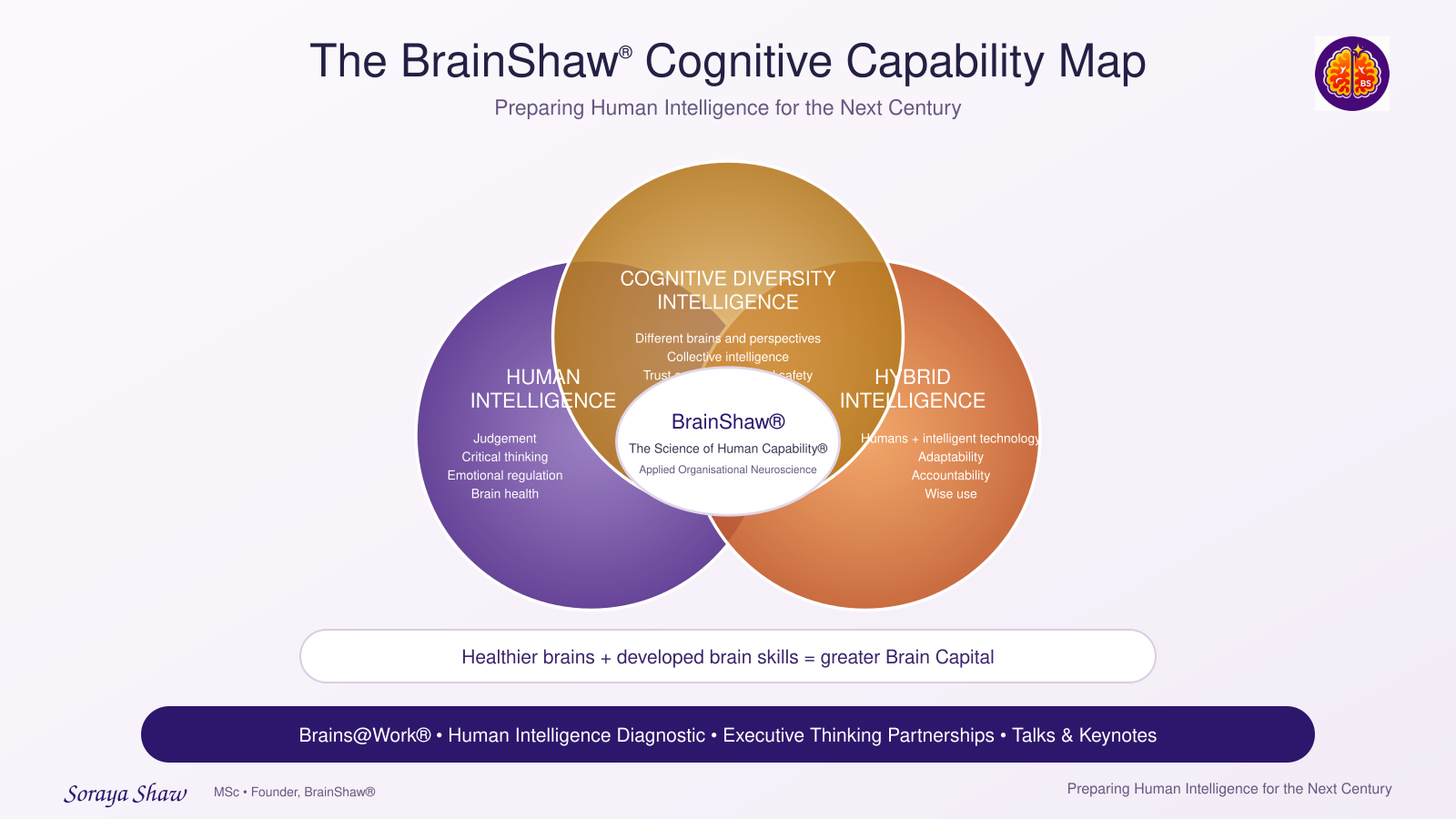
Modern leaders are increasingly orchestrating three interconnected forms of intelligence:
Human Intelligence
The cognitive and emotional capability within each person—including attention, judgement, critical thinking, creativity, emotional regulation, adaptability and metacognition.
Cognitive Diversity Intelligence
The capability created when organisations can genuinely access different brains, perspectives, experiences and ways of thinking—without forcing everybody towards the same answer.
Hybrid Intelligence
The capability created when humans and intelligent technologies work together in ways that strengthen, rather than diminish, human thinking and judgement.
Brains@Work™ brings these forms of intelligence together through The Science of Human Capability®—translating neuroscience into practical organisational insight and action.
Brain Capital begins with brain health
Brain health is not a wellbeing initiative sitting at the edge of organisational performance. It is the biological foundation of attention, memory, emotional regulation, critical thinking, creativity and judgement.
When brains are chronically overloaded, poorly recovered or operating under sustained threat, the organisation has less cognitive capacity available—regardless of the talent it employs or the technology it buys.
Brain Capital brings brain health and brain skills together as an organisational asset. It represents the collective capacity of people to think, learn, adapt, connect and make sound decisions. Brains@Work™ enables leaders to understand where that asset is being strengthened, where it may be depleted and what the organisation can do differently.
What might be happening beneath the surface?
When the human system is under sustained pressure, leaders may notice:
Decisions becoming slower, safer or less consistent.
People struggling to concentrate despite working longer hours.
Technology adoption creating anxiety, resistance or over dependence.
Trust and connection weakening across teams.
Experienced leaders carrying too much cognitive and emotional load.
Meetings increasing without improving the quality of thinking.
Innovation becoming cautious, predictable or difficult to sustain.
Different perspectives being present but not genuinely heard or used.
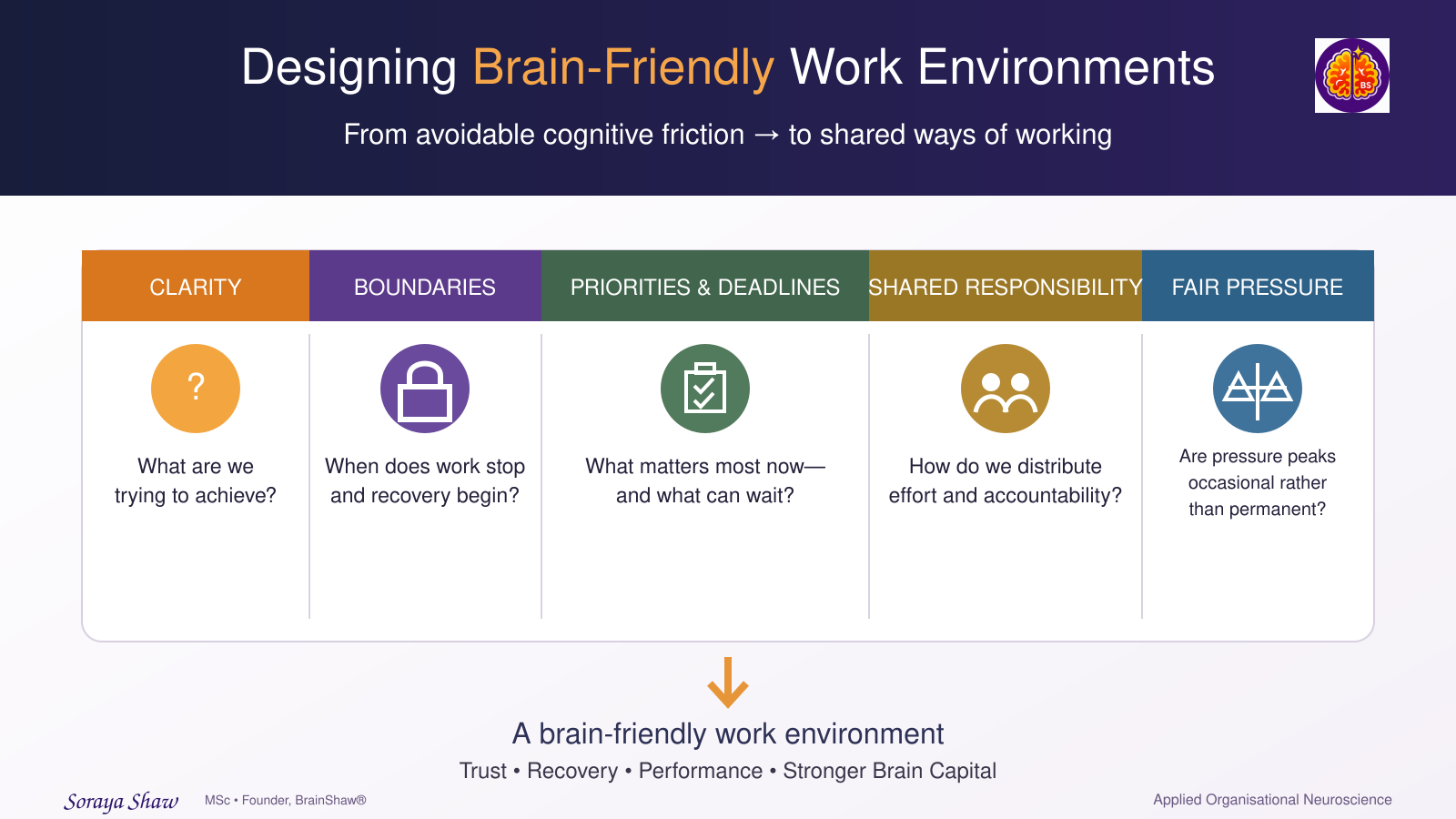
These are not necessarily failures of motivation, competence or leadership. They may be signs that cognitive capacity is being depleted, social threat is increasing or the working environment is placing demands on the brain that it cannot sustainably absorb.
Understanding what is happening beneath behaviour creates the possibility of a more precise response.
Four ways to work with Brains@Work™
Brains@Work™ Human Intelligence Diagnostic
When you need to understand what is affecting your organisation’s ability to think, connect and perform.
The Brains@Work™ Human Intelligence Diagnostic is a neuroscience-informed assessment for leaders and teams. It is not a personality test or clinical assessment. It examines the organisational conditions influencing performance across four brain-based dimensions:
Cognitive Clarity
Emotional Regulation
Social Trust and Safety
Resilience and Adaptability
The diagnostic identifies where Human Intelligence is enabling performance and where cognitive or behavioural friction may be getting in the way. Findings are translated into a visual BrainMap™, strategic interpretation and practical priorities for leaders.
It provides a clearer starting point for decisions about leadership, culture, transformation, brain health and technological adoption.
Human Intelligence Strategy for Boards and Senior Teams
When your organisation has a technology strategy but has not yet defined the Human Intelligence strategy required alongside it.
These facilitated strategic sessions enable boards and senior teams to examine the human implications of AI, automation and wider technological change.
The conversation focuses on what the organisation needs its people and leaders to retain, strengthen or develop; where technology should augment human capability; where over reliance could weaken judgement; and how trust, critical thinking and accountability will be protected.
The outcome is not another abstract debate about the future of work. It is greater leadership clarity about how human and technological capability will work together to create value.
Talks and Keynotes
When you need to make the human implications of technological and organisational change relevant, memorable and difficult to ignore.
Soraya’s talks translate complex neuroscience into clear, commercially relevant ideas that leaders and audiences can recognise and apply.
Topics include Human Intelligence in an age of increasingly powerful technology, Brain Capital, cognition under pressure, critical thinking, cognitive diversity, brain health, burnout and the leadership challenge of orchestrating human and technological intelligence.
Talks can be delivered as keynotes, executive briefings, facilitated conversations or panel discussions.
Executive Thinking Partnerships
When a CEO, founder or senior leader needs a confidential and challenging space for consequential thinking.
Senior leadership can be intellectually isolating. The greater the responsibility, the fewer places there are to think aloud without judgement, internal politics or pressure to arrive at an immediate answer.
Executive Thinking Partnerships combine commercial experience with applied neuroscience to strengthen clarity, challenge assumptions, identify patterns and improve the quality of decisions made under pressure.
This is a senior thinking partnership for leaders to unravel thinking, navigate complexity, transformation and decisions that impact.
Founder Soraya Shaw MSc
Soraya Shaw MSc is an Applied Organisational Neuroscientist, keynote speaker, strategic thinking partner and founder of BrainShaw®.
Before entering neuroscience, Soraya led major international brands and businesses. That commercial experience showed her that even the strongest strategy ultimately depends upon the quality of human thinking, judgement and behaviour behind it.
Long before neuroscience became a fashionable addition to leadership, Soraya trained with David Rock, one of the original pioneers of neuroleadership. She later deepened that early foundation through an MSc in Applied Organisational Neuroscience and developed BrainShaw® to address the next organisational challenge: strengthening the human capability behind leadership, performance and technological transformation.
Her work combines commercial judgement, neuroscience expertise and more than two decades of experience working with leaders and organisations. Recent clients, partners and organisations include Bauer, Chubb, Legal & General, Porsche, The Honourable Society of the Inner Temple, Medik8 and the NHS.